A 1% treaty
How to Redirect $27.2B from War to Medicine - The complete guide to a 1% treaty, the binding global accord that redirects $27.2B annually from military spending to curing disease while maintaining global security.
Abstract
By redirecting 1% of global military spending to hyper-efficient pragmatic clinical trials, humanity can achieve 514 years of medical research in 20 years and shift the cure of every disease forward by 8.2 years, saving 416 million lives and generating $1.2 quadrillion in value.
Keywords
war-on-disease, 1-percent-treaty, medical-research, public-health, peace-dividend, decentralized-trials, dfda, dih, victory-bonds, health-economics, cost-benefit-analysis, clinical-trials, drug-development, regulatory-reform, military-spending, peace-economics, decentralized-governance, wishocracy, blockchain-governance, impact-investing
The 1% Treaty is a legally-binding global accord with a single provision: every signatory nation redirects 1% of its annual military budget to the 1% Treaty Fund, which finances global health initiatives like your decentralized institutes of health (DIH).
The Math
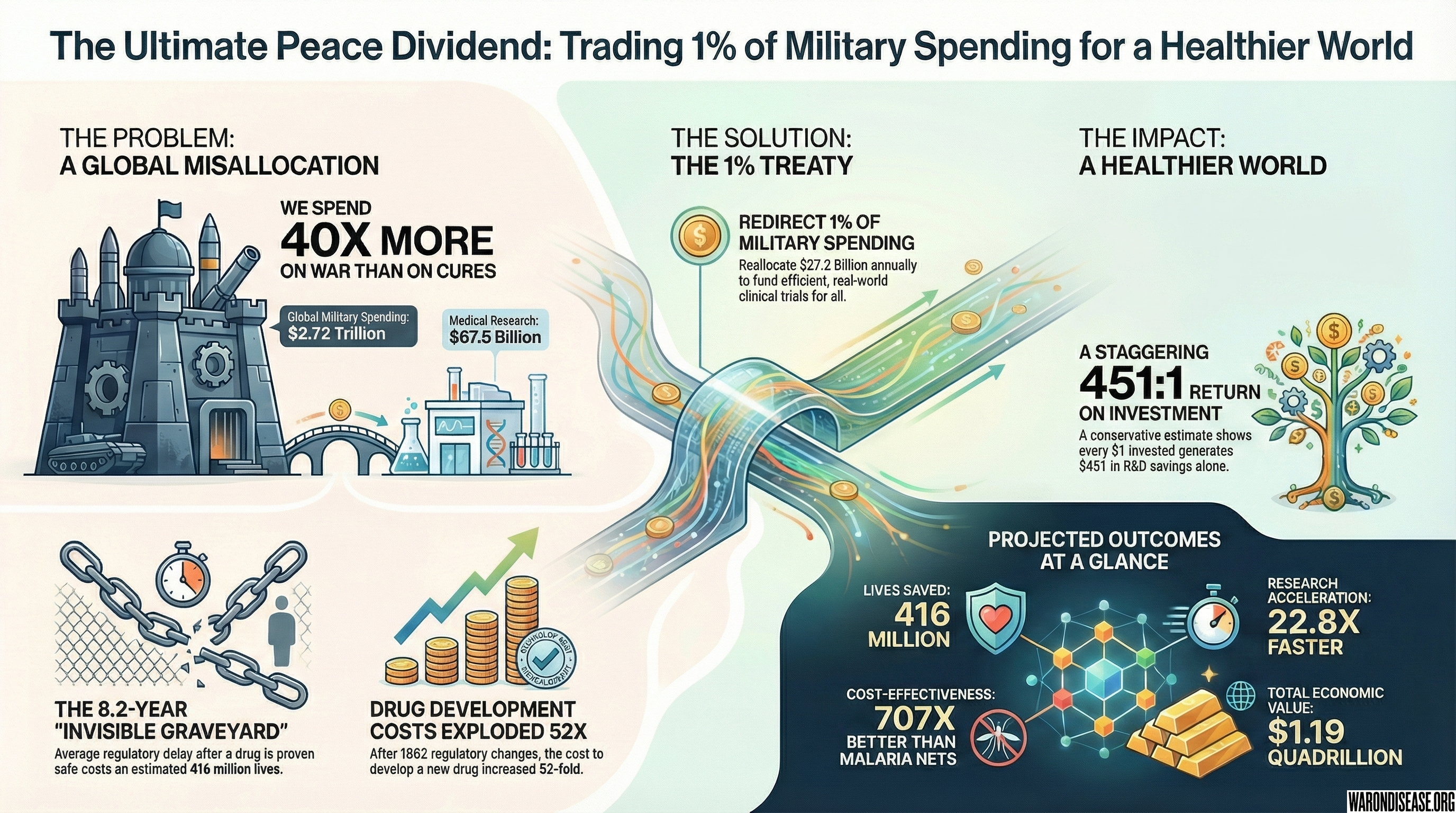
- The Problem: The world spends $2.72T a year on military forces to maintain a delicate balance of power.
- The Hack: If every nation reduces military spending by 1% at the same time, the balance of power remains identical. No country becomes more vulnerable.
- The Prize: That 1%, a $27.2B-a-year river of cash, is redirected to cure all human diseases.
How It Works
- Funding: Creates a $27.2B/year revenue stream for the 1% Treaty Fund
- Execution: A network of decentralized institutes of health (DIH) subsidizes patient participation in a decentralized framework for drug assessment (dFDA), clinical trials that are 82× cheaper than the current model
- Governance: Decentralized Autonomous Organization (DAO) governed by smart contracts and global population via Wishocracy
- Transparency: All research, data, and spending published on public ledger
This Isn’t a Trade-Off. It’s Accidentally Brilliant.
The normal way to sell this: “Sacrifice security for health.”
That’s stupid. Here’s what actually happens:
You Get Two Good Things By Removing One Stupid Thing
When every nation builds 1% fewer explosion devices at the same time, something beautiful occurs:
Good Thing #1: You Become Safer
Everyone keeps the same relative scariness. But the global “we might all die by accident” temperature drops 1%. Fewer chances of:
- Someone pressing the wrong button (happens more than you’d think)
- Countries competing to build the biggest boom stick (expensive and pointless)
- Nuclear weapons launched because a computer thought a flock of geese was a missile (this actually almost happened)
- Wars started over who has the most murder toys
Good Thing #2: You Stop Dying From Stupid Things
That $27.2B pays sick people to try treatments instead of waiting for death.
This is called a Pareto improvement, which is economist-speak for “everybody wins and nobody loses.” It’s like finding out that eating less poison makes you both less poisoned AND wealthier because poison is expensive.
The Dead Capital Problem (Or: Why Bombs Are the Worst Investment Since Tulips)
Here’s something nobody tells you: when countries “invest” in military hardware, they’re not buying assets. They’re buying very expensive paperweights that occasionally explode.
A bridge
- Generates economic activity daily (trucks move, people commute, value flows)
- Lasts 50-100 years
- Makes everyone richer
- Pretty to look at
A missile
- Sits in a hole doing nothing
- Costs $1.5M/year just to keep it from rotting
- Can only destroy things (including itself)
- Makes everyone nervous
This is what economists call “dead capital” - resources trapped in a form that can’t generate returns. It’s like if you converted your house into a pile of TNT. Sure, it’s impressive. But you can’t live in it, rent it out, or do anything except eventually blow it up, at which point you have neither a house nor TNT.
As President Eisenhower (a 5-star General who knew about killing professionally) put it: “Every gun that is made, every warship launched, every rocket fired signifies, in the final sense, a theft from those who hunger and are not fed, those who are cold and are not clothed.”
He literally ran the biggest military in history, and even HE thought you were being ridiculous about this.
A 1% treaty doesn’t ask you to spend $27.2B curing diseases. It asks you to stop wasting $27.2B on things that sit in holes making you poorer and less safe, and redirect those same papers to things that make you richer and less dead.
It’s not spending. It’s stopping wasting.
The Reallocation: How to Redirect $27.2B a Year (Legally)
This is how you redirect $27.2B a year from the military budget to medicine and dying people get better instead.
!Global military spending by region showing the $2.72T humans spend annually on weapons instead of cures
Nobody will even notice.
The Beautiful Mathematics of Mutual Stupidity Reduction
Here’s a fun fact: Every nation on Earth is pointing guns at every other nation on Earth, spending trillions of dollars to maintain what we call “peace.”
It’s like if everyone in your neighborhood spent their life savings on attack dogs, and then called it a “safe community” because all the dogs are equally vicious.
A 1% treaty is based on kindergarten logic so simple that world leaders might actually understand it:
The Proof That Even Generals Can Follow
Current Situation: Every country spends billions on weapons to be exactly as scary as other countries with weapons. Like a very expensive, very deadly Mexican standoff that’s been going on since 1945.
The Elegant Part: If EVERYONE reduces their military budget by exactly 1% at exactly the same time, everyone maintains exactly the same strategic position.
- America: Still has 6,500 nukes instead of 6,565
- Russia: Still has 6,000 nukes instead of 6,060
- China: Still has enough weapons to kill everyone twice instead of 2.02 times
- North Korea: Still terrifying but now 1% less so
The Good Part: Nobody loses! Everyone keeps the same relative scariness! It’s like if everyone at a party agreed to take off their shoes - everyone gets shorter by the same amount, but nobody actually gets shorter relative to anyone else.
The Prize: That 1% - that $27.2B per year - goes into a global fund to cure the diseases that are actually killing people, unlike the bombs which are mostly just sitting around getting dusty and occasionally almost ending the world by accident.
This is straightforward enough that it’s surprising it’s never been tried. And here’s the interesting part: 1% is just the beginning. This is a template for gradually redirecting resources toward human flourishing.
The Blueprint for a Saner World
Treaties are magic pieces of paper that countries sign when they want to pretend they’ll behave.
Sometimes they work (we haven’t had World War III yet). Sometimes they don’t (we’ve had about 200 other wars). But they’re the only tool we have for getting countries to do anything together besides kill each other.
A 1% treaty: Technical Specifications for Global Survival
Article 1: The Promise
“We, the undersigned nations, being of sound mind and tired of dying, hereby agree to redirect 1% of our annual military expenditure to not dying instead.”
Article 2: The Money Part
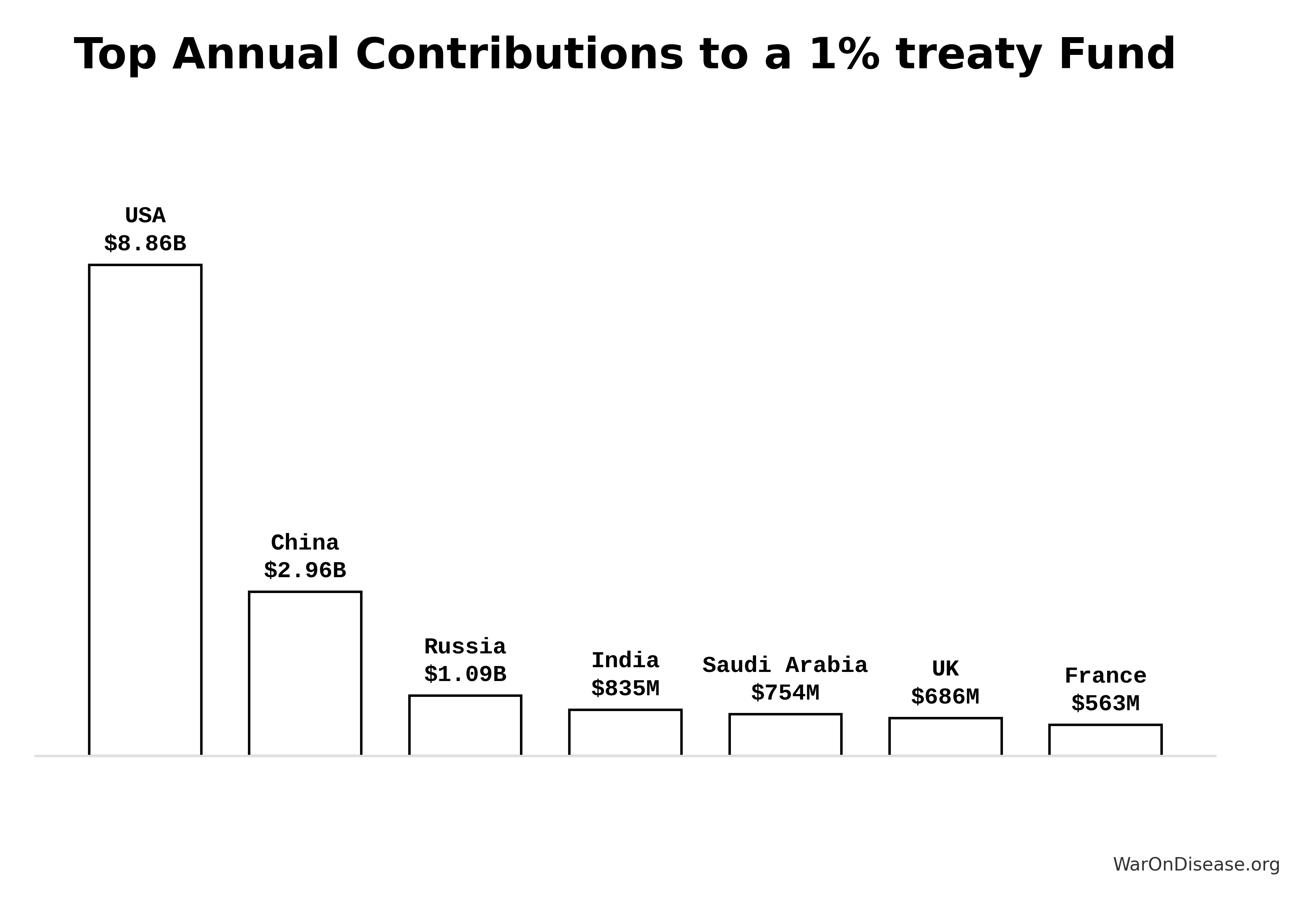
Every signatory nation contributes exactly 1% of their military budget to the 1% Treaty Fund.
- USA: $8.86 billion (won’t even notice, they’ve failed to account for over $2.46 trillion)
- China: $2.96 billion (what they spend on military parades)
- India: $835 million (one aircraft carrier’s wine budget)
- Russia: $1.09 billion (Putin’s shirt budget)
- Saudi Arabia: $754 million (one prince’s yacht)
- UK: $686 million
- France: $563 million (military cheese allocation)
- And so on…
Article 3: The Enforcement Mechanism
If you don’t pay, everyone else gets to call you names at the UN. Also, your citizens find out you chose bombs over their grandmother’s cancer treatment. Good luck with that election.
Article 4: The Escape Clause
Any nation can leave with 1 year notice. During that year, they have to explain to their citizens why they’re choosing death over life. Also, all other nations get to reduce their contributions proportionally, maintaining the balance of terror.
Article 5: The “What If Someone Cheats” Clause
Real-time satellite monitoring of military spending. We can see your secret underground bunkers from space, Kevin. We know about the submarines. Pay up.
Why This Is Actually About National Security (No, Really)
Here’s what actually threatens nations in 2025:
Real Threats (That Actually Kill People)
- Pandemics: COVID killed more Americans than World War II, Korea, and Vietnam combined
- Cancer: Kills 10 million globally per year
- Heart Disease: 18 million annual deaths
- Dementia: Destroying the minds of every nation’s elderly (and sometimes their leaders)
- Climate Disasters: Making entire regions uninhabitable
- Mental Health Crisis: More people kill themselves than die in wars
Fake Threats (That Countries Spend Trillions On)
- Other Countries Maybe Attacking: Happens occasionally, usually over stupid stuff
- Terrorists: Kill fewer people than furniture accidents
- Space Aliens: Still zero confirmed kills
- The Communists/Capitalists: Mostly just sell each other stuff now
- Immigration: People moving around, terrifying
- Critical Race Theory: A graduate seminar that somehow threatens nations
A 1% treaty addresses the real threats without compromising the ability to deal with the imaginary ones.
It’s security policy reframed to address actual threats.
The Rebranding Campaign: From “Weakness” to “Strategic Genius”
Politicians hate looking weak. It’s their biggest fear, right after being caught with their mistress or having to use their own healthcare system.
So you don’t frame this as “reducing military spending.” You frame it as:
“The Strategic Health Defense Initiative”
- Old Frame: “We’re cutting defense by 1%” (Political suicide)
- New Frame: “We’re building a biodefense shield against the real threats” (Political genius)
The Talking Points That Make Hawks Sound Like Doves
For Conservatives: “This is the ultimate America First policy. We’re protecting American lives from the Chinese virus and any future biological threats. It’s the Strategic Defense Initiative for the 21st century.”
For Liberals: “We’re redirecting the tools of war to the cause of healing. This is how we build a more just and equitable world.”
For Nationalists: “Our nation will be stronger when our people aren’t dying of preventable diseases. A healthy population is a powerful population.”
For Economists: “The ROI is 1.19M:1. This beats every other public health intervention on record.”
For Conspiracy Theorists: “Big Pharma hates this one weird trick that makes medicine basically free.”
For Everyone: “Your mom has cancer. This might cure it. Sign here.”
The Implementation Timeline (Or: How to Boil Humanity Slowly)
Phase 1: The Whisper Campaign (Months 1-6)
Start rumors in defense circles. “Have you heard about the 1% solution?” Make it sound like a secret military strategy. Use PowerPoints with lots of arrows.
Phase 2: The Think Tank Infection (Months 6-12)
Get RAND Corporation and other military think tanks to write impenetrable 400-page reports on “Biosecurity Through Cooperative Threat Reduction.” Nobody will read them, but everyone will assume they’re important.
Phase 3: The Media Blitz (Months 12-18)
Leaked documents. “EXCLUSIVE: Secret Pentagon Plan to Save Humanity.” Get it on Joe Rogan. Then CNN. Then Fox News, but frame it as owning the libs somehow.
Phase 4: The Political Theater (Months 18-24)
Congressional hearings where generals explain that biodefense is the real defense. Show charts of Chinese biotech investments. Use words like “asymmetric advantage” and “force multiplication.” Politicians nod sagely while understanding nothing.
Phase 5: The International Cascade (Months 24-36)
Once three major powers sign on, everyone else panics about being left behind. It’s like when one kid gets a Pokemon card and suddenly everyone needs Pokemon cards.
Countries that sign early get “Founding Member” status, which means nothing but sounds important.
Phase 6: The Victory Lap (Month 36+)
Every politician claims credit. Nobody remembers who opposed it. History books call it “inevitable.” Everyone pretends they’re not surprised it worked.
The Money Flow: Where $27.2B Actually Goes
Once the treaty is signed and the money starts flowing, here’s what happens:
The 1% Treaty Fund
Input: $27.2B annually from military budgets worldwide
Distribution: The $27.2B flows into the 1% Treaty Fund, where it is allocated using an 80/10/10 automatic split before any funds reach discretionary spending:
| Allocation | Percentage | Annual Amount | Purpose |
|---|---|---|---|
| Pragmatic Clinical Trials | Patient subsidies, R&D, pandemic prep | ||
| VICTORY Incentive Alignment Bond Returns | 10% |
$2.72B |
Perpetual investor payments |
| IAB Political Incentives | 10% |
Rewards for supporting legislators |
The 80% allocated to pragmatic clinical trials is then distributed by the people of Earth via the Wishocracy platform. There are no committees or central planners. While allocations are dynamic, initial priorities determined by the crowd are projected to focus on:
- Patient Subsidies: The largest portion, creating a market for clinical trials.
- Research & Development: Funding for breakthrough platform technologies.
- Pandemic Preparedness: A global insurance policy against the next COVID. The exact percentages will shift in real-time based on humanity’s collective will.
Governance: Governance is handled by Wishocracy, a system of direct digital democracy detailed in the ‘How to Replace Congress With an App’ chapter. In short: every human gets direct say on funding priorities. Yes, even Florida Man. We’ll risk it.
Year One Projected Outcomes
Right now, only 5 million people participate in trials annually out of 2.4 billion with chronic disease. A 1% treaty changes this:
Current System
- Pivotal trials: $41K per patient
- Only 5M participants per year globally
- 99.8% of willing participants turned away
- 17 years to approve one drug
With a 1% treaty + a decentralized framework for drug assessment
Year One Outcomes
- 50,000 new treatments tested
- 1 million patients enrolled in trials
- 100+ diseases with new treatment options
- 0 new nuclear weapons built with that money
- ∞ political careers saved by claiming credit
The Incentive Structure
The military-industrial complex will LOVE this.
Why? Because they get to:
- Keep 99% of their budget (still plenty for bombs)
- Pivot 1% to biotech (higher profit margins)
- Look like heroes (rare for arms dealers)
- Invest in the fund (272% annual returns, remember?)
- Not die of cancer (even arms dealers get cancer)
Lockheed Martin Presents: The F-35 Cancer Killer™ Boeing Proud Sponsor of: Not Dying of Alzheimer’s Raytheon Technologies: Now With 1% Less Death
They keep their contracts. They keep their profits. They just point 1% of their death machines at actual death. This isn’t just about saving lives; it’s about creating a substantial growth industry, the business of not-dying, and letting everyone get rich in the process.
What Happens If This Actually Works
The Endgame: Reorienting Global Priorities
A 1% treaty isn’t the goal. It’s the beginning. It’s the opening wedge that demonstrates a better way to allocate resources. Your multi-generational strategy is to make organized violence less economically necessary. You’re not appealing to better angels; you’re making peace more profitable than war.
The Ratchet Effect: How to Boil a Frog (The Frog is the War Machine)
Once a 1% treaty is signed and the first cures for “untreatable” diseases start rolling out, the system becomes more valuable. This is how you sustain it.
Every five to ten years, you organize another global vote. The question is simple: “Hey, that worked out great. Grandma’s dementia is manageable and we stopped that pandemic before it started. Want to try another half-percent?”
It’s a politically tiny ask with an enormous payoff. This creates a feedback loop from hell for the “war is good, actually” crowd. More cures lead to more popular support, which leads to more votes for more funding, which leads to more cures. It’s a self-reinforcing flywheel for peace. The military budget gets put on a diet, one delicious, life-saving, politically-unassailable bite at a time.
The Economic Gold Rush
Eventually, the economic gravity of the planet will shift. The most talented scientists and engineers will be drawn to the massive opportunities in health and longevity, not designing better ways to blow people up. The world’s biggest investors will realize the greatest returns are found in curing Parkinson’s, not in building another aircraft carrier.
Nations will find that true power and global influence come not from their capacity for destruction, but from their contributions to human flourishing. The new geopolitical competition won’t be about who has the most weapons, but about who achieved the most breakthroughs in medicine.
A Multi-Generational Timeline
Year 1: The Awkward Beginning
- Politicians argue about who thought of it first
- Military contractors rebrand as “health defense” companies
- First cures emerge, everyone pretends they’re not surprised
- Global military spending: Still $2.69 trillion (nobody notices the difference)
Year 5: The New Normal
- Cancer survival rates double
- Alzheimer’s has three new promising treatments
- The “Redirect” is now at 3%. Military budgets naturally decline because healthy, happy people are less interested in starting wars.
- Some country tries to quit, gets voted out of office by angry grandmothers.
Year 10: The History Books
- “A 1% treaty: How Humanity Chose Life Over Death”
- Military spending down to 90% of 2025 levels. The redirect is at 10%.
- Former weapons manufacturers are now the world’s leading producers of artificial organs and gene therapies.
- Nobel Peace Prize goes to whoever takes credit (probably Switzerland).
Year 50: The View from Tomorrow
- Death is mostly optional. War is mostly a video game.
- The redirect is at 50.0%. The military-industrial complex now builds starships and planetary defense systems against asteroids.
- Children learn about cancer the way we learn about polio.
- Someone writes a book called, “Remember When Humans Used to Kill Each Other? What Idiots.”
The Counter-Arguments (And Why They’re Stupid)
“But what if our enemies don’t reduce their spending?”
They do, or they’re not part of the treaty. It’s simultaneous. Like synchronized swimming, but with less drowning.
“This makes us weak!”
You still have 99% of your weapons. You can still end the world. You’re fine.
“The military creates jobs!”
So does medical research. More, actually. And the workers don’t get PTSD.
“This is socialism!”
No, it’s math. Also, the military is already socialism. This is just socialism that saves lives instead of ending them.
“It’s too complicated!”
We put humans on the moon with slide rules. We can figure out how to move money from Column A to Column B.
“What if there’s a war?”
There’s always a war. We’ll still have 99% of our capacity to wage it. Plus, healthy populations fight better. Ask the Spartans. (Actually don’t, they’re all dead. But you get the point.)
Summary
A 1% treaty is a piece of paper that says “Let’s spend 1% less on killing and 1% more on not dying.”
That’s it. That’s the whole thing.
It doesn’t end war. It doesn’t destroy the military. It doesn’t create world peace.
It just moves the first 1% of our murder budget to our survival budget.
If we can’t agree on that - if we can’t agree that spending 1 penny less on death and 1 penny more on life is a good idea - then we deserve whatever’s coming.
Addendum: The Actual Treaty Text (First Draft)
THE TREATY FOR THE 1% REALLOCATION OF MILITARY EXPENDITURES TOWARDS BIOMEDICAL RESEARCH AND DEVELOPMENT FOR THE PREVENTION OF HUMAN SUFFERING AND DEATH
(Or: The “Let’s Not Die” Treaty, for short)
WHEREAS, humanity spends $2.72T annually on methods of killing itself;
WHEREAS, this seems somewhat counterproductive;
WHEREAS, diseases kill more people than all wars combined and don’t even have the decency to be quick about it;
WHEREAS, we have nuclear weapons sufficient to end civilization 20 times but can’t cure male pattern baldness once;
WHEREAS, this is embarrassing;
NOW, THEREFORE, the undersigned nations agree to stop being complete idiots about this, as follows:
Article I: Each signatory shall redirect exactly 1% of its annual military budget to the 1% Treaty Fund, starting immediately or whenever their legislature gets around to it, whichever comes first.
Article II: This money shall be used exclusively to cure diseases, extend human life, and make existence less horrible.
Article III: Any nation caught spending this money on weapons shall be mocked relentlessly at international gatherings.
Article IV: This treaty shall remain in force until humanity either cures death or causes its own extinction, whichever comes first.
IN WITNESS WHEREOF, the undersigned, being of sound mind and tired of watching their loved ones die of preventable diseases, have executed this Treaty.
Signed this day, ____________, in the year of our ongoing confusion, 2025.
[Nation Name] “We choose life, I guess”
P.S. - If your nation doesn’t sign this, your citizens will find out you chose bombs over their medical care. Good luck with that.
P.P.S. - Yes, this includes space weapons. Nice try.
Reuse
Copyright
© 2025 Mike P. Sinn