Wishocracy
war-on-disease, 1-percent-treaty, medical-research, public-health, peace-dividend, decentralized-trials, dfda, dih, victory-bonds, health-economics, cost-benefit-analysis, clinical-trials, drug-development, regulatory-reform, military-spending, peace-economics, decentralized-governance, wishocracy, blockchain-governance, impact-investing
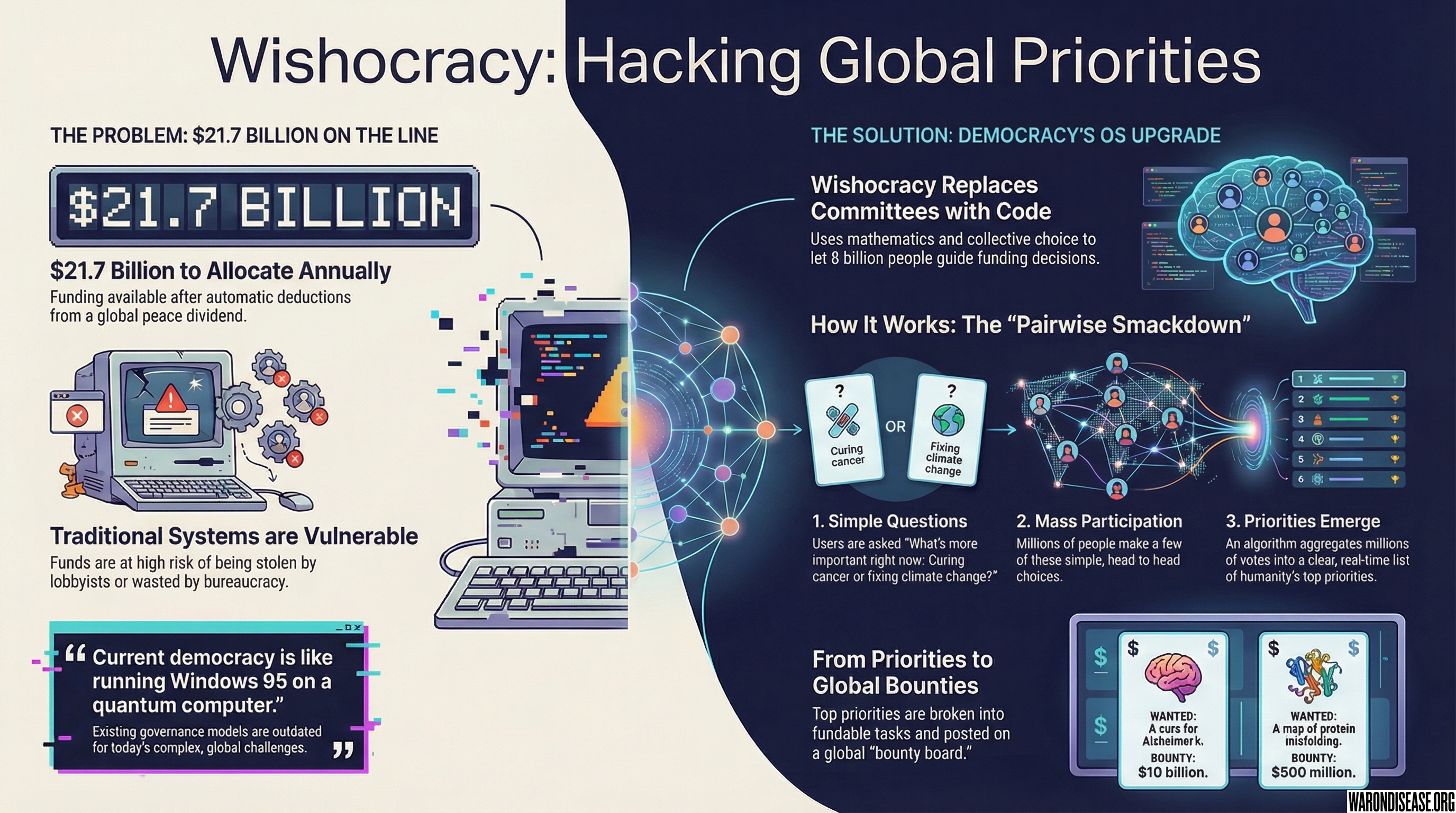
Congratulations! You’ve passed a 1% treaty and now you’ve got $27.2B/year flowing into the 1% Treaty Fund.
But not all of it is available for allocation. First, the automatic deductions:
| Allocation | Share | Amount | Purpose |
|---|---|---|---|
| VICTORY Incentive Alignment Bond investors | 10% |
$2.72B |
Repay campaign funders |
| Political incentives (IABs) | 10% |
Keep politicians aligned | |
| Available for Wishocracy | $21.7B | What you get to allocate |
How do you avoid parasitic special interests from stealing that $21.7B or bureaucracy from wasting it all?
Wishocracy replaces committees with code and representatives with mathematics. It’s how you let 8 billion people collectively decide how to spend $21.7B without it turning into a bureaucratic nightmare.
How Wishocracy Allocates the 1% Treaty Fund: Decentralized Crowdfunding
Your decentralized institutes of health (DIH) network functions as a decentralized crowdfunding platform. Anyone can submit a campaign proposal. Wishocracy allocates funds from the 1% Treaty Fund across competing campaigns.
What your decentralized framework for drug assessment (dFDA) handles automatically:
- Which specific treatments get tested → Companies register, patients choose
- Which diseases get researched → Patients join trials for their conditions
- Resource allocation within pragmatic clinical trials → Market prices and participant choices
What Wishocracy Actually Decides:
Allocation across campaign proposals competing for 1% Treaty Fund funds:
Infrastructure Campaigns
- “Decentralized Framework for Drug Assessment Development” - $1B/year proposal
- “Epic EHR Integration Project” - $5M one-time
- “AWS Infrastructure Services” - $3M/year
- “Security Audit Program” - $2M/year
- “Alternative decentralized framework for drug assessment” - $8M/year (competing approach)
Public Goods (Market Failures)
- “Patient Trial Subsidies Program” - $800B/year (automatic formula)
- “Off-Patent Drug Research” - $20B/year
- “Rare Disease Initiative” - $10B/year
- “Negative Results Publishing Fund” - $5B/year
Service Provider Bids
- “Data Storage Provider A” - $2B/year
- “Data Storage Provider B” - $1.5B/year (competing)
- “Pragmatic Clinical Trial Insurance Pool” - $10B reserve
How It Works: Pairwise Comparisons Between Campaigns
Instead of committees deciding “a framework for drug assessment gets $10B,” the global population votes using pairwise comparisons:
“What’s more important right now:”
- “Framework for drug assessment development” vs “Alzheimer’s prize”?
- “Epic integration” vs “Security audits”?
- “Rare disease research” vs “An alternative drug assessment framework”?
- “Patient subsidies” vs “Infrastructure spending”?
Millions of people make simple pairwise choices. The algorithm aggregates preferences into funding allocations.
Why This Is Actually Needed (Not “Just 3 Parameters”)
You can’t reduce this to simple formulas because:
- Multiple competing implementations - Which decentralized framework for drug assessment to fund? Which infrastructure provider?
- Trade-offs between prizes - $100B for aging reversal or $50B for Alzheimer’s + $50B for cancer?
- Public goods allocation - How much for off-patent drugs vs rare diseases?
- Service provider competition - Which companies get contracts for what amounts?
Your decentralized framework for drug assessment (dFDA) allocates resources within pragmatic clinical trials. Wishocracy allocates resources between campaigns.
The core of Wishocracy is a voting method so simple, even a congressman could do it. It’s called Aggregated Pairwise Preference Allocation, or simply, the Pairwise Smackdown.
Your brain can’t rank a list of 20 priorities. It gives up around item number seven. But it’s fantastic at comparing two things.
Instead of asking, “Rank these 10,000 problems,” the system asks:
“What’s more important right now: Curing cancer or fixing climate change?”
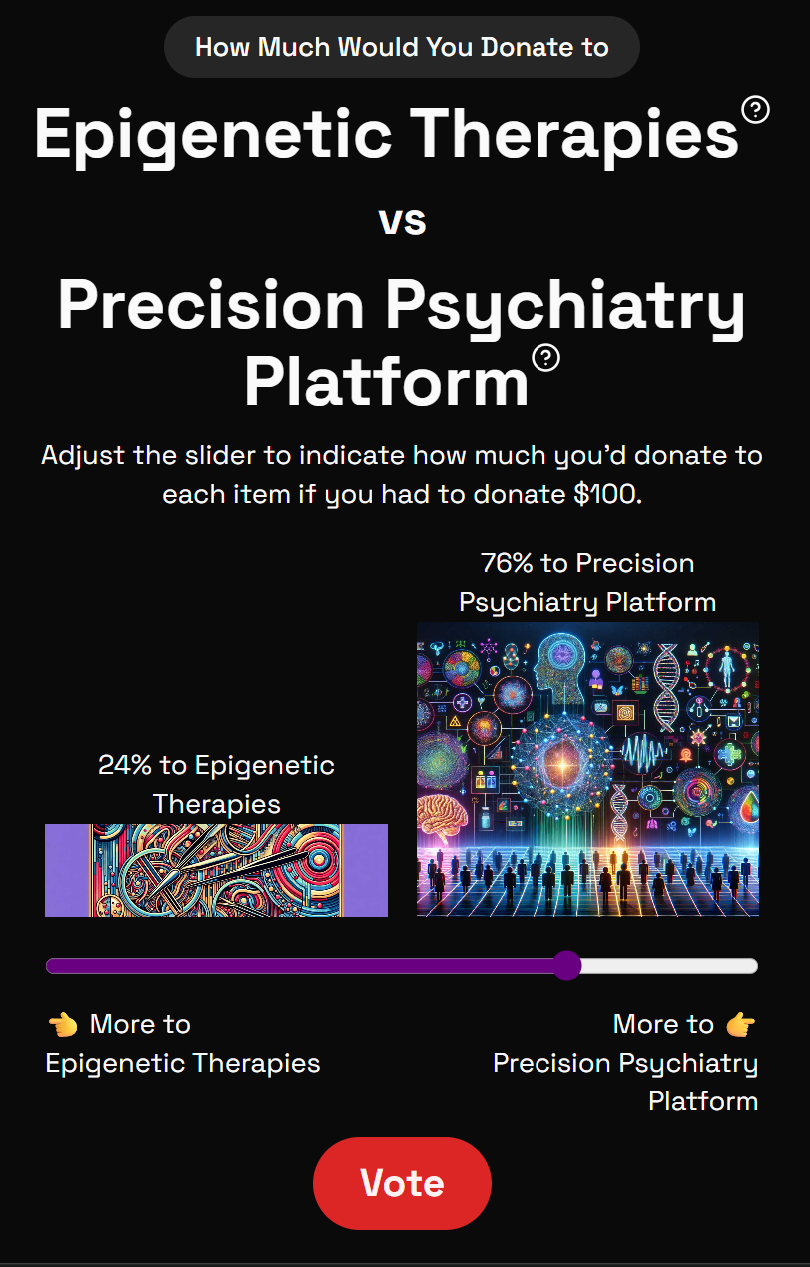
You make a choice. That’s it. You do this a few times with different random pairs. It takes five minutes. Millions of other people do the same. An algorithm then takes these millions of simple, head-to-head “smackdowns” and builds a perfect, real-time ranking of humanity’s collective priorities.
It’s the wisdom of crowds, but without the crowds having to talk to each other.
Why This Actually Works (Math Warning)
When millions of people make pairwise choices:
- Random pairs prevent gaming
- Statistical models (Bradley-Terry, PageRank) extract global preferences
- Outliers cancel out
- Wisdom of crowds emerges
Example with real numbers:
- 5 million people vote
- Each makes 20 comparisons
- 100 million data points
- Algorithm crunches numbers
- Output: “Humanity wants 28% on healthcare, 22% on education, 15% on climate…”
It’s democracy without the stupidity. We still get the stupidity, but it’s evenly distributed and thus cancels out.
From Priorities to Projects
Once the Pairwise Smackdown tells you that “Curing Alzheimer’s” is a top priority, Wishocracy translates that priority into action.
AI Breaks It Down: An AI takes the impossible goal of “Cure Alzheimer’s” and breaks it down into thousands of smaller, concrete, fundable tasks. “Cure Alzheimer’s” becomes “Map protein structures,” which becomes “Run AlphaFold on these sequences,” which becomes “Rent computing time.” Every impossible problem is just a series of possible steps.
The Bounty Board: These tasks are posted to a global marketplace. It’s like eBay, but for saving humanity.
- WANTED: A cure for Alzheimer’s. BOUNTY: $10 billion.
- WANTED: A map of all protein misfolding patterns. BOUNTY: $500 million.
The World Competes: The best teams from around the world, from MIT to some kid in a garage, bid on these tasks. Multiple approaches are funded in parallel. The ones that show promise get more funding. The ones that fail are defunded instantly. It’s venture capital, but for not dying.
We Already Do This, Just Badly
Every time you:
- Like something on social media (micro-vote)
- Buy something on Amazon (economic vote)
- Choose a restaurant (quality vote)
- Swipe on dating apps (genetic vote)
You’re participating in distributed decision systems. We’re already a hive mind. We’re just a badly organized one.
Wishocracy just makes it official, efficient, and pointed at problems that matter.
Instead of our collective intelligence being used to:
- Determine which cat videos go viral
- Optimize ad targeting
- Make billionaires richer
- Argue about pronouns
This system directs it to:
- Cure diseases
- End poverty
- Fix climate
- Explore space
- Make existence not suck
Same collective intelligence. Better targets.
Democracy’s Operating System Upgrade
Democracy 1.0 was designed for:
- 13 colonies
- 3 million people
- Horse-based communication
- Life expectancy of 40
- Three total issues (British bad, taxes bad, freedom good)
Democracy 2.0 (representative democracy) was designed for:
- Nation states
- Millions of people
- Telegraph communication
- Life expectancy of 60
- Dozens of issues
Wishocracy is Democracy 3.0, designed for:
- Global civilization
- 8 billion people
- Instant communication
- Life expectancy of ∞
- Infinite, interconnected issues
It’s not replacing democracy. It’s making it work.
Current democracy is like running Windows 95 on a quantum computer. Wishocracy is finally installing the right OS.
Will it be perfect? No.
Will it make mistakes? Yes.
Will it be better than letting cocaine-addled politicians decide based on bribes? Absolutely.